Experiment
Football Logos by Color: Why Blue and Red Rule
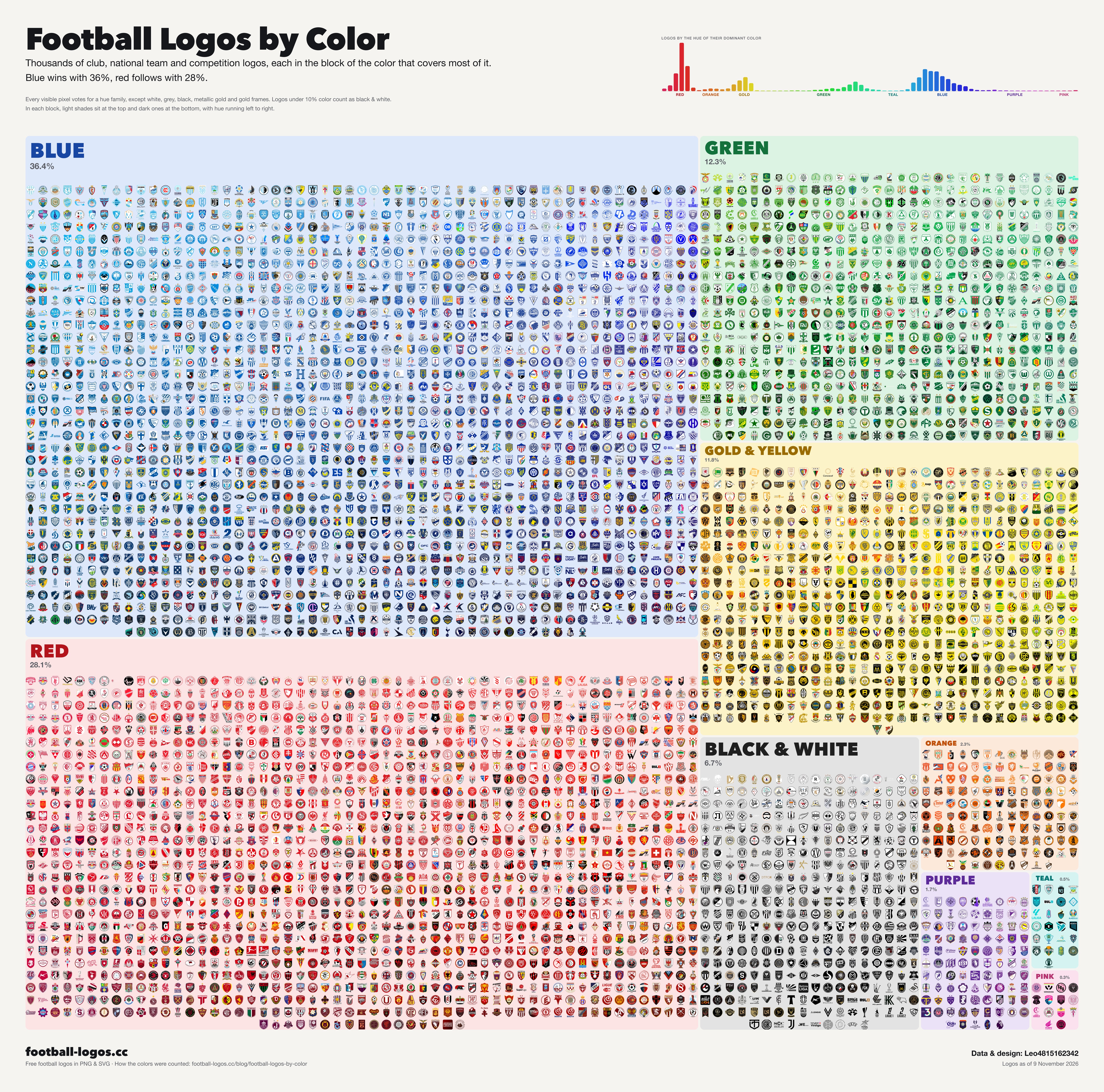
We've scanned thousands of football logos and analyzed their colors. Blue came first, red second, and together they beat every other color combined.

By Leo4815162342 · 7 min read
Scroll through football-logos.cc for a while and you see a lot of blue, and a lot of red. We wanted to know whether that was real or just our impression, so we took every club, national team and competition logo on the site, thousands of them, worked out each one's dominant color and sorted them all into one big mosaic.
Blue is the most common color in football (soccer) logos, and red comes second. Between them they cover 65% of all logos, more than every other color put together. Green and gold & yellow are a long way behind, and purple, teal and pink hardly show up.
All of this is measured in code, so "dominant" means the color that wins the pixel vote below, which isn't always the color a club is known for.
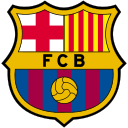
Few football crests are a single color. Barcelona's has a gold rim, a red cross, the Catalan stripes and the blaugrana bars, so picking one color takes a few rules. Below are ours, and near the end, our guesses at why blue and red come out on top.
How we found each logo's dominant color
Every pixel votes for a color family, with a few exceptions. The demo after the rules runs the same code in your browser on a few well-known logos.
- 1. Take the pixels. We read each logo's 128 × 128 PNG and weight every pixel by its alpha, so the transparent background drops out and anti-aliased edges count partly.
- 2. White, grey and black don't vote. White fields, black outlines and lettering cover 42% of the average logo. If they voted, 38% of logos would come out white, grey or black.
- 3. Neither does gold trim. Dull, metallic gold and bronze count as metal and don't vote, and neither does gold along a crest's outline, which we treat as a frame unless the crest has no other color.
- 4. Every other pixel votes by hue for one of eight families: red, orange, gold & yellow, green, teal, blue, purple or pink. Dark pinks go to red, because in football claret and maroon are reds.
- 5. The family with the most votes wins. The busiest 15° of hue within it gives the logo's shade. If less than 10% of a logo votes at all, it goes in black & white.
1Take the logo
128 × 128 PNG, pixels weighted by alpha.
2Pixels vote
Faded pixels don't vote: white, grey, black, dull gold and gold frames.
3Count by hue
Votes by hue in 5° bins. The arc marks the winning family.
4Biggest family wins
With under 10% color, a logo counts as black & white.
We didn't expect Barcelona to come out gold & yellow. But even with the gold rim left out, 34% of the crest is gold, mostly the Catalan stripes, the FCB band and the ball, while red covers 26% and blue only 13%. Real Madrid went the other way, because once its gold rim was out of the count, the blue band (31%) beat the gold that was left (22%). Sevilla's red wins the same way. PAOK's gold is dull enough to count as metal, so their crest ends up black & white, which is what they wear anyway. Atlético Madrid, the rojiblancos, come out blue because of the blue field behind the bear. Beşiktaş play in black and white too, but the red Turkish flag on their crest covers 12% of it, just enough to clear the 10% bar.
The gold rules are our own judgment calls, and they get some logos wrong. LAFC's crest is black and gold, but its gold is as muted as the laurel wreath on Udinese's, so both end up black & white. Counting area is crude in another way too, since a big background beats a small detail even when the detail is the part fans care about. We still think it's good enough to say which colors football likes, as long as you don't read too much into any single logo.
The most common colors in football logos
Blue is the dominant color of 36.4% of football logos and red of 28.1%. Then come green at 12.3% and gold & yellow at 11.8%, and 6.7% of logos are black & white. Everything else is rare (orange 2.3%, purple 1.7%, teal 0.5%, pink 0.3%), and pink is down to a few logos, Inter Miami's and Dulwich Hamlet's among them.
- Blue36.4% · in 46.7%
- Red28.1% · in 43.8%
- Green12.3% · in 19.6%
- Gold & yellow11.8% · in 32.4%
- Black & white6.7%
- Orange2.3% · in 6.4%
- Purple1.7% · in 2.3%
- Teal0.5% · in 1.1%
- Pink0.3% · in 0.7%























Gold shows up in 32% of logos (the pale bars) but wins only 12%, because even bright gold is mostly trim, like crowns and stars, around a crest's main colors. Without the two gold rules it would have won about 17%. Heraldry treats gold the same way. It's one of the two metals, and the rule of tincture puts metal against color so a shield reads from a distance.
Red and blue also behave differently. Football's red is almost always the same red, and 25% of all logos have their dominant shade within 10° of pure red. That's the tall spike in the chart below. Blue is spread out, from the sky blue of Aston Villa and Napoli to the navy of Tottenham and Boca Juniors.
355°–360°: 13.0% of all logos
Perceived vs measured club colors
Most people know a club's colors from its shirt, and the crest doesn't always follow. We looked up the current home shirts of 600 clubs and national teams for the site's wallpapers, and for 71% of them the crest's measured color is one of the shirt's colors.
Real Madrid and Barcelona from the demo are the best-known exceptions. Newcastle are the Magpies, but black and white don't vote, so the light-blue scroll under their shield decides. Brazil play in canary yellow with a mostly blue badge, and Les Bleus wear a gold rooster. White never wins either, so 86% of the teams in plain white shirts come out in their crest's color instead, like Tottenham in the navy of their cockerel.
-
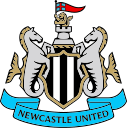 Newcastle United Home shirt: black and white stripes Crest: Blue 24%
-
 Brazil National Team Home shirt: gold & yellow Crest: Blue 57%
-
 France National Team Home shirt: blue Crest: Gold & yellow 96%
-
 Celta Home shirt: blue Crest: Red 53%
-
 Norwich City Home shirt: gold & yellow Crest: Green 71%
-
 Tottenham Home shirt: white Crest: Blue 100%
Why are so many football clubs blue or red?
Nobody assigns club colors, so it's odd that so many clubs ended up with the same two. We can't prove why, but we have a few ideas from the history of club colors, and they all point the same way.
Heraldry is the obvious place to start, since a crest is a coat of arms at heart. Red, or "gules", was by far the most common color in medieval coats of arms, and in the 12th century the most popular pair was gold and red. Blue caught on later. Towns and regions kept their arms for centuries, and some clubs simply took their colors from them, like Roma, who still play in the yellow and red of the city of Rome.
Colors also spread by copying, often from English clubs. Juventus started out in pink shirts, and when those kept fading in the wash they switched to Notts County's black-and-white stripes. Athletic Club brought red-and-white shirts back from Southampton and handed the spares to their Madrid offshoot, the club that became Atlético. Sparta Prague dropped black for Arsenal's dark red after their president saw Arsenal play in 1906. In England, where club football started, blue and red lead too, with 36% and 32% of club logos.
And people simply like these colors. In a YouGov survey of ten countries on four continents, blue came out as the favorite color in every one. For red there's a 2008 study, which found that English teams that wear red won the league more often than you'd expect from how many of them there were, though people still argue about whether the shirt has anything to do with it.
We also expected neighbors to pick opposite colors, red against blue like in Liverpool, Manchester and Munich, but the data doesn't back that up. Two clubs from the same city share a color family 28% of the time, about the same as two clubs picked at random (28%).
How we counted
- Logos: every club, national team, league, cup and federation logo on football-logos.cc on 9 November 2026. Only current logos count, not old versions or monochrome variants, and brands are left out.
- Pixels: each logo's 128 × 128 PNG. Pixels under 16% alpha count as background, and the rest are weighted by their alpha.
- White, grey and black: a pixel doesn't vote when its saturation is under 18%, its lightness is under 8% or over 93%, or its RGB channels are within 18 of each other.
- Gold: orange and gold pixels under 45% saturation count as metal and don't vote. Gold within 4 pixels of the logo's outline (3% of its width) counts as a frame and doesn't vote either, unless no other family covers 5% of the logo.
- Families: they start at 340° (red), 12° (orange), 33° (gold & yellow), 70° (green), 170° (teal), 190° (blue), 255° (purple), 315° (pink), where the hue chart is quietest. From 315° to 340°, shades darker than 40% lightness count as red.
- Shirts: the current home shirts of 600 clubs and national teams, looked up for the site's wallpapers. The main color and the second color, if there is one, go into the same families as the pixels, with white, grey and black as black & white. A crest matches when its color is one of the shirt's.